
Cassia County Release Date Meanings
Idaho Department of Correction does not currently publish one field called a generic projected release date. Its public detail records may show a Sentence Satisfaction Date, Parole Eligibility Date, Next Parole Hearing Date, Retained Jurisdiction End Date, and Released to Supervision. The Idaho Commission of Pardons and Parole may publish a Tentative Parole Date after a grant decision. Each answers a different question.
A sentence satisfaction date relates to the active sentence endpoint. Parole eligibility is the point when discretionary consideration may become available. A hearing date schedules a procedure. A tentative parole date remains conditional. Released to Supervision looks back to the latest placement on court or Commission supervision. None alone guarantees the hour or even the final day of physical release.
Pretrial status is different. A person awaiting case resolution at Mini-Cassia may be released after bond, own recognizance, dismissal, or another court action, but the charge and bond display cannot be used as a date calculator. A detainer, which is another authority’s request to hold or receive the person, can also change the outcome.
Search Cassia County Release Dates
Choose the record system by custody type. State prisoners belong in the IDOC Resident/Client Search. County jail dates require the jail event record and court order. Commission records add hearing and parole-decision context. The systems complement one another but do not share identical meanings.
- Confirm whether the person is in Mini-Cassia, IDOC, another county, or federal custody.
- For IDOC, search by name or IDOC number and match the identity and Cassia County case fields.
- Record every date with its full label, source, status, and observation date.
- Review the court judgment for the fixed and indeterminate sentence terms and any jail credit.
- Check the Commission decision when parole is involved, then confirm actual status with IDOC.
- For Mini-Cassia, call the jail and request the recorded release event rather than computing from charges.
The current jail roster and Recent Bookings list admissions and present-custody data. Neither publishes a release timestamp, destination, or release reason. Disappearance from the roster is therefore a lead only. Call Mini-Cassia at (208) 878-1000 and ask whether the identified booking ended by community release or transfer.
A narrow written request should include the full name, booking ID, date range, and requested fields. Ask for the actual release date and time, release type, destination or receiving custodian if releasable, and associated booking number. The signed court order controls legal authority; the jail event controls the physical departure from that jail.
Idaho Release Date Fields
The public IDOC detail screen is valuable because it keeps different sentence concepts apart. Its field labels should remain intact in notes, messages, and records requests. A person can have multiple cases or sentences, so one visible date may not describe the controlling total.
| Official field | What it means |
|---|---|
| Sentence Satisfaction Date | Endpoint associated with the active sentence calculation. |
| Parole Eligibility Date | Date discretionary parole consideration may become available. |
| Next Parole Hearing Date | Procedural date for Commission review, not release. |
| Tentative Parole Date | Conditional Commission date after some grant decisions. |
| Retained Jurisdiction End Date | Date tied to Idaho’s retained-jurisdiction process. |
| Released to Supervision | Past date of the latest placement under community supervision. |
The IDOC example detail screen shows how status, location, case, offense, supervision, satisfaction, and eligibility data appear together.
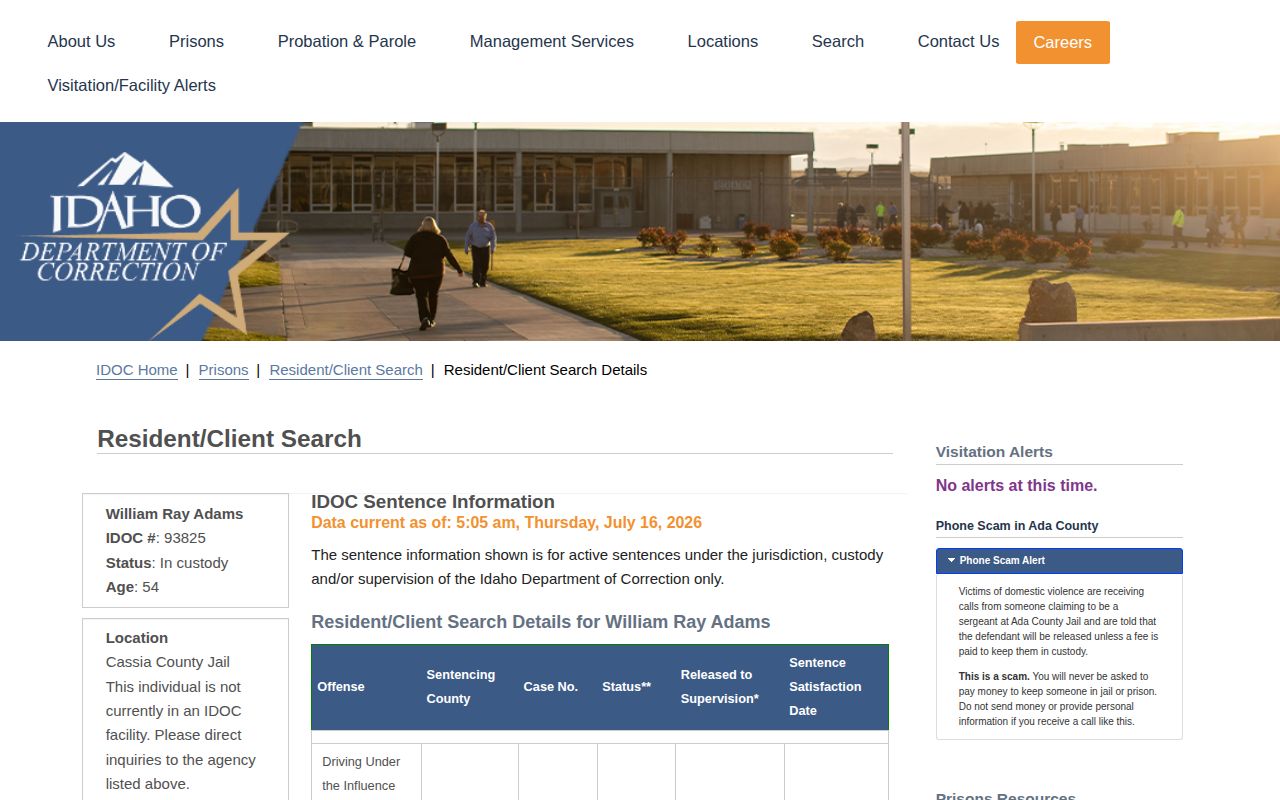
The screen demonstrates why the label must travel with the date. A bare date copied out of context can turn parole eligibility into a false release promise.
Cassia County Fixed-Term Rules
Idaho Code section 19-2513 requires the sentencing court to state a minimum fixed period and permits an additional indeterminate term. During the fixed minimum, the person is generally not eligible for parole, discharge, or ordinary good-conduct reduction. Idaho’s fixed term is ordinarily served at 100 percent. It is not accurate to apply a broad 85-percent shortcut.
The indeterminate portion is where discretionary parole consideration can operate, subject to the sentence and special law. Eligibility does not equal a grant. A grant does not equal immediate release. Commission dates remain tentative until required programs are complete and IDOC approves the parole plan.
- Fixed term
- The minimum period of confinement imposed by the court.
- Indeterminate term
- The added sentence span during which parole discretion may operate.
- Parole eligibility
- The point when consideration may occur, not a release promise.
- Sentence satisfaction
- The sentence endpoint shown by the controlling correctional calculation.
County jail computation is separate. The official Cassia research found no public county good-time policy, date calculator, weekend adjustment rule, holiday rule, release hour, or exit procedure. Credit for time served and commitment terms can matter, but the judgment and jail record must supply the answer.
Cassia County Good-Time Limits
Idaho does not provide ordinary day-for-day prison good time within this truth-in-sentencing structure. Idaho Code section 20-101D is a narrow exception for extraordinary meritorious service. It concerns acts such as heroism risking one’s life, saving life, preventing major property loss during a riot, or preventing escape.
The statute permits no more than 15 days for each month sentenced, but that maximum formula does not turn the provision into routine earned time. An award can also be withdrawn under governing rules. Medical parole is another exceptional authority and is not a standard calculator input. Neither supports estimating an individual’s date without an official record.
This distinction is the defining Idaho release-date issue. Public records use PED, sentence satisfaction, released-to-supervision, and Commission TPD fields. Anyone recording a Cassia County date should quote the exact field rather than relabel it “projected release.”
Why Cassia Release Dates Change
A future date can move or fail to become the actual release event. Only state a cause when the court, correctional, or Commission record supports it for the person involved.
| Factor | Possible effect |
|---|---|
| Amended court order | Clarifies or changes the controlling sentence terms. |
| Concurrent or consecutive cases | Changes how multiple sentence spans combine. |
| Jail credit resolution | Changes credited time in the official calculation. |
| Parole decision | A grant, denial, continuance, or pass to full term changes the path. |
| Programs and parole plan | Incomplete requirements can delay a tentative parole date. |
| Detainer or new legal event | Can lead to another custodian or alter physical release. |
| Database lag | Can leave a public field behind the official event. |
A court may clarify a sentence. The Commission may continue or deny a hearing. Programs may remain incomplete. IDOC may not yet approve the parole plan. Each event has its own record. Avoid attributing delay to discipline, a hold, or another reason unless the cited case record says so.
Confirm Cassia County Release Dates
For a parole path, review the Commission’s Notice of Action Taken, then verify program and plan status where publicly confirmable. Next check IDOC status and Released to Supervision. Direct IDOC confirmation or a VINE alert completes the sequence. No one is released before the tentative date, but the listed date still does not guarantee release on that day.
For a county sentence, obtain the judgment from the Cassia court and the release-event record from Mini-Cassia. The Judicial Center court counter, not the County Courthouse, handles the court record. Ask the jail whether departure was community release or a handoff. For notice of a pending change, use the VINE Inmate Check, then confirm the resulting event with the custodian.
Dates work best as labeled evidence. Keep the custodian, field name, source, and check date together. That practice prevents a parole eligibility date, sentence endpoint, or past supervision date from becoming an unsupported promise about when someone will leave custody.
Cassia Parole Decision Dates
Commission outcomes require exact wording too. “Grant Parole” may carry a tentative date. “Deny Parole” may identify a later hearing month. “Deny Parole and pass to full-term release date” points toward the sentence endpoint, while “Continue” means the decision remains pending. Revocation records can reinstate parole. These are decisions, not a list of completed physical releases.
Regular parole and revocation calendars identify people by name and IDOC number. Notices can also list the decision, next hearing, tentative parole date, comments, and denial reasons. Hearing schedules and posting dates can change. Match the IDOC number and use the newest official notice before drawing a conclusion.
Cassia Federal Release Date Records
A federal case follows a separate path. BOP may display a release date for a sentenced federal prisoner, but “Not in BOP custody” remains custodian-specific and can reflect transfer to another authority. A federal pretrial detainee is traced through the U.S. Marshals Service and the federal court. Immigration custody is checked through ICE.
None of those dates should be merged with the Mini-Cassia event merely because the person was once housed in Burley. Cassia booking data has carried federal and immigration hold types. Confirm the county checkout first, then follow the receiving agency. The physical facility and the legal custodian can differ.
Public Record Search
Sponsored Results